

The past year taught the industry that attackers will use frontier AI models to move faster than any patch cycle. Autonomous network mitigation is how defenders answer in kind. It closes the attack path to the reachable 1% of vulnerabilities at machine speed, at the network choke point, without touching the business systems behind it. And humans hold the keys at every step.
Here’s why we built it, and how it works.
The Problem: Why Now
The exploit now arrives before the change window does. Frontier AI models have pushed attacker effort toward zero, while the defender's path from advisory to patch still runs at human speed.
Volume was already hard to keep up with, with 48,185 CVEs published in 2025.
Then 2026 broke the curve. The monthly count has climbed every month since April, and the first ten months of 2026 (89,859 CVEs) already passed all of 2025.
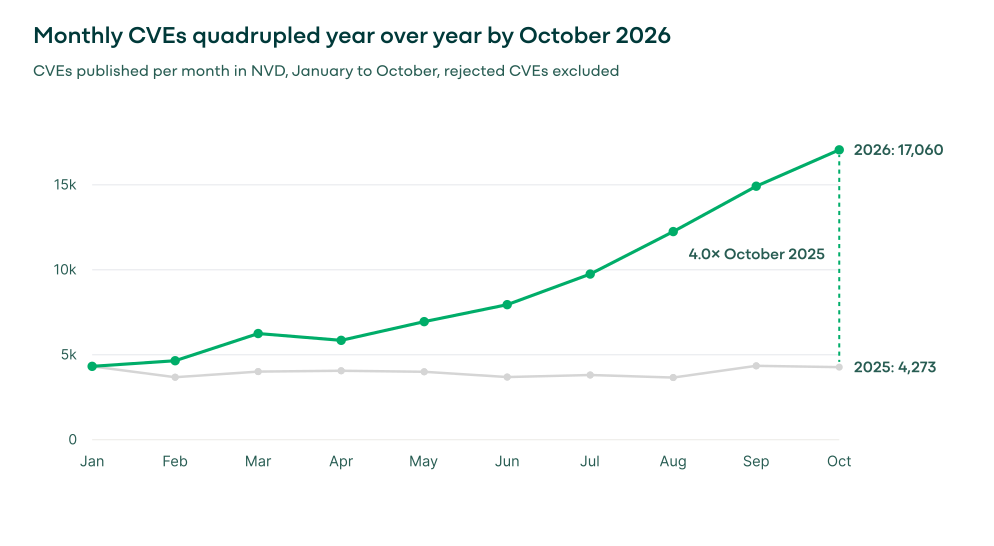
NVD, rejected CVEs excluded · Jan–Sep from Brandefense (pulled 26 Oct 2026), Oct 2026 from Jerry Gamblin's monthly CVE stats
Defenders went the other way. In Verizon's 2026 DBIR, exploitation became the top way breaches start, at 31%. The median time to patch rose from 32 to 43 days, and organizations fully remediated only 26% of known exploited vulnerabilities.
This fall's critical flaws showed how short that window has become. PHP2Shell, two RCE flaws in the PHP core, drew tens of thousands of attack attempts within the first hour after the patch shipped, and one probe was seen four days before disclosure. HTTP2Shell, an RCE in the Brotli decoder used by Node.js and Python, was under attack within its first day. And SSHole, an OpenSSH authentication bypass, saw its first exploitation attempt less than nine hours after its CVE was published.
Reachability hasn’t changed. Exploits arrive faster, but they still need a route through firewall rules, segmentation and NAT to reach a vulnerable service, and only about 1% of findings have one.
Even at 1%, a backlog of millions leaves thousands of reachable, exposed vulnerabilities. Each of them still needs a vendor fix, a change window and someone to own the change, and exploitation often starts long before all three are in place.
Why Mitigation, Not Just Faster Patching
Patching is still the fix. It just can't be the first response anymore. For years, security teams have been told to patch faster, and that advice stops working when the exploit lands days before the change window opens.
Autonomous remediation has become the industry's answer, but it inherits the patch's problems. It still changes the vulnerable system, and in a large enterprise every change to a business-critical system needs a window, a rollback plan and an owner. Often there is nothing to apply at all: the vendor hasn't shipped a fix, or for end-of-life systems never will.
Autonomous network mitigation sidesteps both problems. Instead of changing the asset, we block the path an attacker would use to reach it.
Patching and autonomous remediation both wait for a vendor fix and a change window on every server. Autonomous network mitigation waits for neither: one rule at the choke point covers every server behind it, works on end-of-life and OT systems, and rolls back cleanly. It doesn't replace the patch. It holds the line until the patch lands.
What Makes Our Approach Different
The industry is converging on the same answer. In a recent post, Nikesh Arora, CEO of Palo Alto Networks, argued that frontier models are exposing vulnerabilities faster than enterprises can patch them, especially smaller teams and OT environments. Every patch still has to be tested in its own environment first. "The most obvious solution is virtual patching," he writes, but it isn't comprehensive enough today and has to scale fast.
The same pressure is breaking an old rule of software: production changes only when the source code does. When an exploit can arrive within hours, the answer is a narrow live fix in the running system first, then a code fix that retires it.
Together, these requirements make a useful bar for any live fix.
Three things set our approach apart:
- Reachability decides what to mitigate. We only mitigate the 1% attackers can reach. Generic risk scores paired with automation only automate the waste.
- Topology decides where. The same data that proves a vulnerability is reachable shows the narrowest point to cut it off. Nothing on the asset changes, so business-critical and OT systems stay online.
- Your policies decide how. Mitigations apply on their own only within the automation rules each organization sets, with human approval wherever those rules require it.
How It Works
Autonomous network mitigation runs as a dedicated agent in Astelia Agents, and every mitigation follows the same six steps. The analysis is the same reachability engine customers already use; what's new is that it now ends in an action.
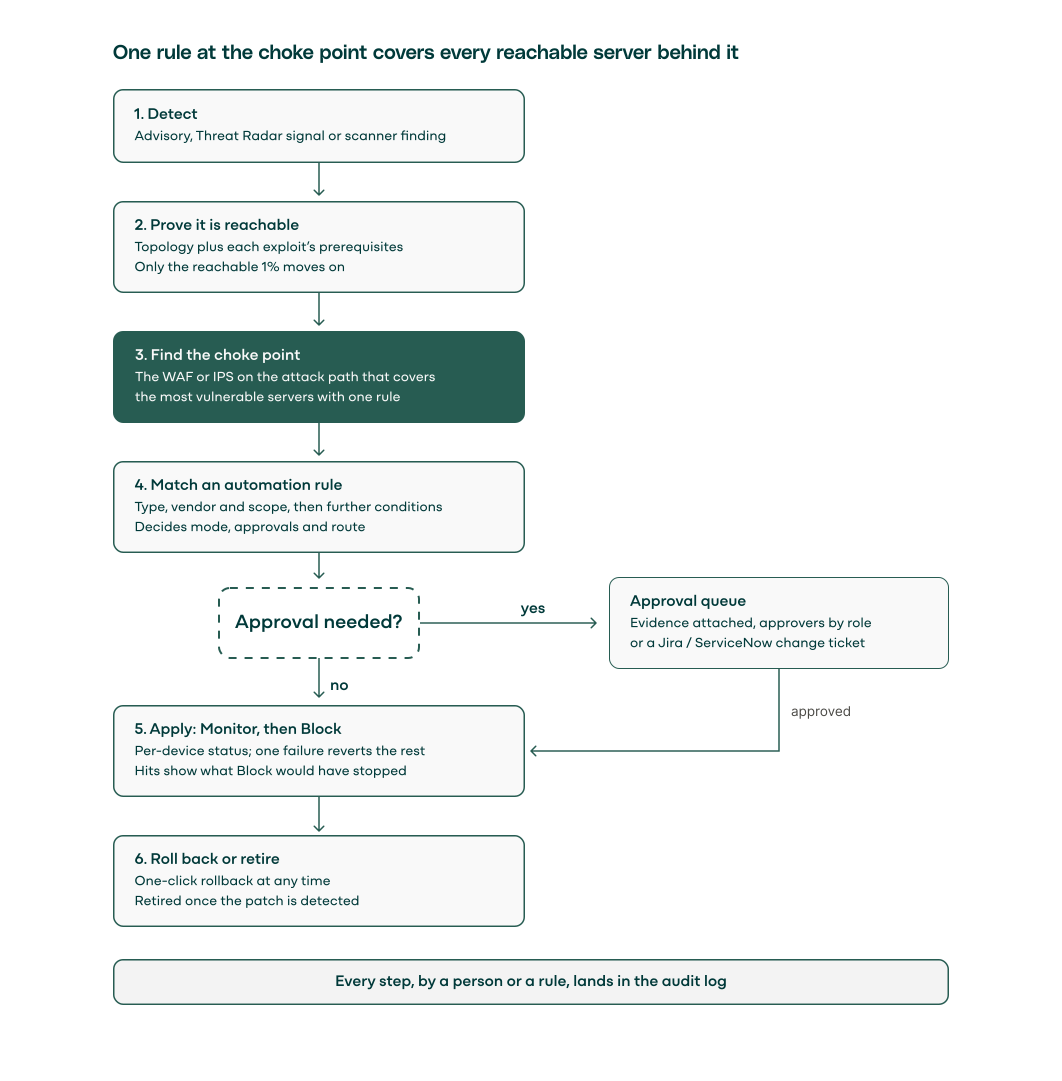
The choke point is what makes this scale. Patching the same exposure would take one change per server; mitigating it takes one rule on the device every attack path already crosses.
The recommended rollout
Most teams won't hand the network to an agent on day one, and they shouldn't have to. We recommend widening autonomy in four steps, each one earned by the audit trail of the last:
- Recommend only. Astelia proposes each mitigation with its evidence; people apply it.
- Monitor on its own. Let a narrow rule, such as trending one-days on IDS signatures, apply in Monitor mode without approval. Nothing is blocked yet, but the hits are real.
- Block with approvals. Promote to Block mode with approvers each rule, and route firewall changes through a change ticket where the Change Advisory Board (CAB) requires it.
- Widen rule by rule. As the audit log shows clean promotions and few rollbacks, give more rules the right to act on their own.
Guardrails: Agents Execute, Humans Decide
Autonomy is only useful if the organization can trust it on its own production network. So every mitigation runs inside automation rules the customer writes, and every step leaves a trail.
Automation rules. A rule starts with its key decisions: which mitigation types it covers (IPS/IDS signature, WAF rule), from which vendors, and on which firewalls and network components. It can then narrow further on any criterion Astelia tracks, such as threat signal (early signal, trending one-day, infamous), Risk Status (attack path, reachable, exposed), owner or number of assets covered. Rules are checked top to bottom and the first match decides, with a catch-all at the bottom so nothing falls through.
What a rule decides:
- Mode: apply on its own in Monitor or Block, or only recommend.
- Approvals, per mode: how many approvers (none to three), which roles can approve, how long the request stays open, and whether an emergency path lets one manager push it through. A requester can never approve their own request.
- Route: push directly to the device, or open a change ticket in Jira or ServiceNow and wait for the CAB.
Auto-mitigation touches the following four groups, and each one needs a different guarantee before it will trust the system:
Kill switch. One switch pauses every rule and routine at once. Rules already on a device stay until someone rolls them back.
Rollback. Any mitigation rolls back in one click. Rules are applied device by device, and if one device fails, the others revert automatically. Once the patch is detected on the asset, the rule is flagged for retirement, so live fixes don't pile up.
Audit. Every request, approval, application, promotion, rollback and retirement is logged with who did it (a person or a rule), when, what changed before and after, and on which devices.
Least privilege. Astelia's analysis keeps running on read-only integrations. Mitigation uses scoped write permissions that each organization turns on per vendor, and can turn off at any time.
An Example: PHP2Shell
In October 2026, the PHP2Shell (CVE-2026-109618 and CVE-2026-109619) remote code execution flaws hit, and end-of-life PHP servers had no official fix to apply. For those servers, a network mitigation was the only protection available. Yet our research found that only 10% of enterprises applied any network mitigation within 24 hours of PHP2Shell's publication. Approval processes held them back, along with missing business context on what a block might break.
Here is how that plays out in Astelia:
- Detection. PHP2Shell appears in Threat Radar as a trending one-day. Astelia's reachability analysis checks every affected instance against the topology and keeps only the ones an attacker can reach.
- Rule match. The customer's top automation rule says: trending one-days on IPS signatures get Monitor mode immediately, with no approval; Block mode requires approval from both the security manager and the network owner.
- Monitor, on its own. The autonomous network mitigation agent pushes the vendor's IPS signature in Monitor mode to the firewall at the choke point. One signature covers every reachable PHP server behind that gateway.
- Evidence. As traffic flows, the rule shows matched traffic and the requests it would have blocked, with top sources and targets.
- Block, with approval. The promotion to Block waits in the approval queue with that evidence attached. The security manager approves, then the network owner does, and the rule switches to Block.
- Rollback, if needed. If a legitimate application starts failing, any approver rolls the rule back in one click, and the audit log records why.
- Retirement. When a server is upgraded off the vulnerable PHP version, Astelia detects the patch and flags the rule for retirement, so the firewall doesn't collect rules that no longer protect anything.
The security team's manual work comes down to two approval clicks. Every reachable server was covered from the moment the signature existed, not from the moment a patch did.
What's Next
Initial support covers WAF and IPS/IDS rules. Next, mitigation extends to firewall rules, and uses the firewall's own traffic to make each rule as precise as possible: catch more real exploitation, block it, and leave legitimate business traffic alone.
- Firewall rules: deny rules that close an exposed port or path, including when no signature exists yet.
- Traffic log analysis: before a rule is proposed, read the firewall's traffic logs to see who actually reaches the vulnerable service. Live traffic from the internet confirms the attack path is real and raises its priority. Known business flows are mapped, so the rule blocks the attack path and keeps them open.
- Hit count analysis: track hits on every rule Astelia places. Hits from exploit traffic show the rule is working. Hits from legitimate sources flag it for review before it moves from Monitor to Block, and rules with no hits show where the policy can be tightened.
- Canary rollout: apply a rule to a subset of devices first and promote it once the hits look clean.
Also on the roadmap: drift detection, approvals from Slack and Microsoft Teams, SLA escalation, and a link to the remediation workflows in Astelia Agents, so the same flow that places the rule also drives the patch and retires the rule.
Attackers have moved to machine speed. Now the reachable 1% can be closed just as fast, and the patch can follow on its own schedule.
Schedule a demo to see autonomous network mitigation in action.