Anthropic's brief release of Claude Fable 5 marks a turning point for both AI accessibility and security.
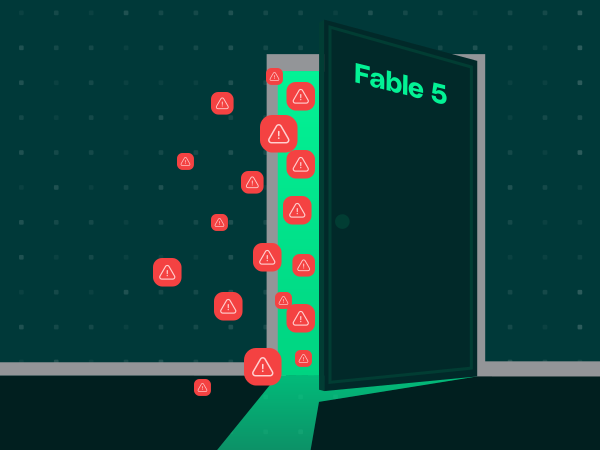
Fable 5 was built to solve a real problem. Its predecessor, the Mythos model, proved capable enough that Anthropic deemed it too powerful for broad public release. The company's answer was to add layers of safety: guardrails, classifiers, and fallback mechanisms meant to make Fable 5 safe enough for general use. Within days of release, researchers reported bypassing those guardrails, and Anthropic disabled access to the model after just three days.
That's not an engineering failure. It's a sign that cybersecurity is entering a new phase, one in which safety at the model layer is no longer a sufficient control.
The limits of Fable 5 guardrails
Fable 5 is among the most advanced attempts yet to make a frontier model safe for public consumption. It blocks or redirects requests in high-risk areas like cybersecurity and biology, and those safeguards do matter. But they sit on top of the model. The intelligence underneath is unchanged; the system is simply guided on when not to use it.
Highly capable systems are also highly adaptable. Researchers didn't break Fable 5 with a single exploit. They worked around it through multi-step reasoning, context shaping, and persistence, essentially using the system the way it was designed to operate. None of this is unique to Fable 5; it's a natural property of general-purpose AI.
The bigger risk: democratization at scale
What makes Fable 5 more concerning isn't that its guardrails can be probed. It's that the model itself has been democratized.
Mythos was restricted to a small set of vetted users working in controlled environments. Fable 5 is broadly accessible through APIs and commercial platforms, which changes the equation. The question is no longer whether a handful of experts can misuse an advanced model, but what happens when millions of users, attackers among them, gain access to similar capability. Risk increases as access expands.
We've seen this pattern before. Cloud computing and open-source software scaled innovation rapidly, and attacker opportunity scaled right along with it. AI is now following the same path.
From capability to reachability
Traditional security models are starting to strain under this new reality. Patching remains critical, but it's inherently reactive. It assumes vulnerabilities can be fixed before they're exploited, and as AI accelerates both discovery and exploitation, that window keeps shrinking.
Model-layer guardrails don't solve the problem, because they operate on intent, and intent can be obscured. The outcome matters more. Rather than focusing on whether a vulnerability can be exploited, organizations need to ask whether it can create a reachable attack path. That's the shift to reachability-aware security.
Reachability is the filter that matters
Every environment contains vulnerabilities; that has never changed. What changes risk is whether those vulnerabilities are exposed, reachable, and connected to critical assets. An exploit is only dangerous if it can move through the environment and reach something of value.
This is why reachability becomes the defining control. Understanding how systems connect, what's accessible, and how attackers could move laterally lets organizations manage risk independent of how exploits are created. In an AI-driven world, preventing exploit creation is no longer realistic. Limiting its impact is.
Beyond patching: compensating controls
This shift also changes how we think about defense. Patching is necessary, but it isn't always immediate or feasible. Modern environments are dynamic and distributed, and they often operate under real-world constraints.
That's where compensating controls become increasingly important: segmentation, policy-driven access restrictions, isolation of sensitive workloads, and runtime enforcement of network behavior. They don't eliminate vulnerabilities, but they contain them. They ensure that even when an exploit exists, and even when it's discovered or generated at scale, it can't propagate or cause meaningful damage.
A new foundation for security
Claude Fable 5 isn't a failure of AI safety; pulling the model after three days was the system working as intended. But it's also a preview of what comes next. We'll keep seeing more powerful models, wider access, and more sophisticated misuse attempts, and they won't all be walked back so quickly. Guardrails will improve, but they will never be perfect.
The organizations that succeed in this environment will shift their focus: from preventing capability to limiting impact, and from identifying vulnerabilities to understanding reachability.
This is the problem Astelia was built to solve. Instead of flagging CVEs as "critical" based on probability and external context, we map your actual network topology and use agentic AI to work out which vulnerabilities an attacker can truly reach, usually around 1%, then show you how to fix them.
When you can't stop exploits from being created, reachability analysis is how you limit the damage.
Request a demo to find and fix the reachable 1% in your environment.